
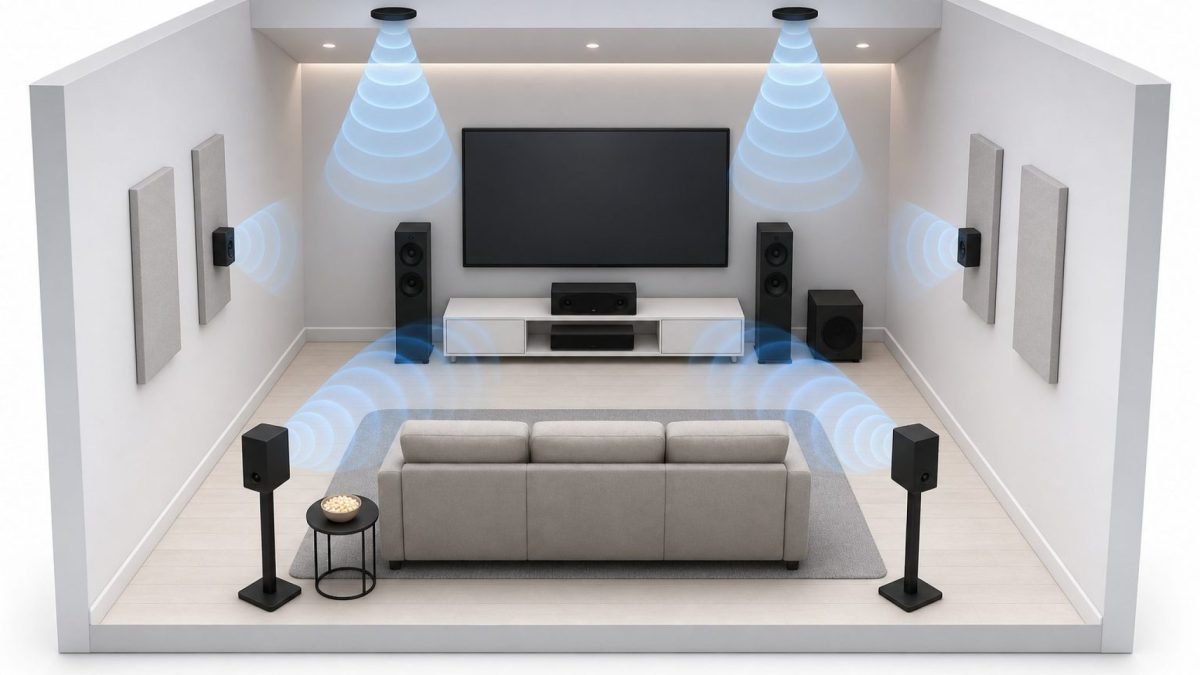
Do you like your soundbar, but your favorite movies still lack that finishing touch? Do you want impressive sound depth and realistic effects that place you right in the middle of the action? Do you want to hear raindrops falling from the ceiling like in the cinema, and be amazed by the special effects?
Then Dolby Atmos paired with a home theater power manager is exactly what you’re looking for. Where the limits of a stereo system or Bluetooth speakers have already been reached, home theater comes into the picture.
We don’t just supply the necessary passive speakers or sets individually, but also complete, coordinated sound systems including REFLEKT speakers for Dolby Atmos. Of course, Dolby Atmos setups also come with a matching AV receiver and a powerful subwoofer for the necessary bass. The world of three-dimensional sound is just a click away!
What is Dolby Atmos?
Unlike Dolby Digital, Dolby Surround, or DTS, the Dolby Atmos audio format theoretically allows the playback and processing of an unlimited number of soundtracks. Strictly speaking, there’s no such thing as a “Dolby Atmos” speaker, but there are licensed speakers that reproduce these audio tracks.
Since in theory every movie scene, and every object visible in it, is also meant to be sonically reproduced, these formats are also known as object-based. Because each speaker receives its own distinct signal based on the actual movie scene, the audio is designed so that you feel like you’re right in the middle of the action.
Furthermore, far more signals and data are processed than with Dolby Digital or DTS, so you perceive far more detail and precision. You can immerse yourself directly in the movie and enjoy the action with all your senses. For the special audio signals you hear from the ceiling or “from above,” the AV receiver has matching connections on the back that you can hook up during installation.
How do I set up my speakers for Dolby Atmos?
You can easily connect REFLEKT speakers to your existing surround system if you have the required connections on the AV receiver. You can set up REFLEKT speakers as “reflecting speakers,” for example, on top of a floor-standing speaker. To do this, set the switch on the back to “reflective mode.”
This way, the sound is reflected off the ceiling, so you can enjoy it from your couch. Alternatively, you can use REFLEKT as a “direct speaker.” To do this, set the switch to “direct mode” and mount the speakers on the front wall just below the ceiling, so the sound is directed at an angle toward the listening position.
This way, you can enjoy the sound from your seated position.
This lets you perfectly match your Dolby Atmos system to your room for the best surround sound.
Where do I connect the speakers for Dolby Atmos?
Don’t have much experience connecting speakers? Not a problem. Keep in mind that channel labeling can vary depending on the brand of your AV receiver, so use the receiver’s setup wizard for configuration and connection. This way, you can correctly assign the channels meant for the Atmos signals.
With newer AV receivers, a diagram is shown on your TV screen, and the speaker connections are clearly labeled. When buying speakers, make sure you get a set with 7 speaker channels (“7.1 or 7.2”). With “Atmos receivers,” you can configure the last 2 channels as outputs for ceiling speakers.
Alternatives to Dolby Atmos
In addition to Dolby Atmos, there are other audio formats that also process and reproduce 3D sound signals. These are currently DTS:X and Auro-3D. The main difference is the amount of data processed. With DTS:X, this is significantly higher, providing more detail in theory, at least in simple mathematical terms.
With Dolby Atmos, at least 2 speakers are required for these signals. With Auro-3D, there are 4. Because of this, Auro-3D requires an AV receiver with at least 9 separate connections.
Can I use Dolby Atmos through streaming services like Netflix and Amazon Prime? Unfortunately, this isn’t fully possible yet. Currently, movies are streamed in Dolby Digital 5.1 at most by streaming services. The data volume for Dolby Atmos signals is significantly larger, so it isn’t yet possible to stream them online.
For the best picture and sound quality, you’ll only achieve it with Blu-ray. You’ll also need to connect the Blu-ray player to the AV receiver via an HDMI cable. You can only use the Blu-ray player this way if your TV has HDMI eARC and can also process the audio signal.
Connect directly to the TV and route the sound to the AV receiver via HDMI eARC. But even if you’re not receiving an Atmos signal, you can use your AV receiver’s settings to create virtual 3D sound, which will still play through the speakers connected to the “Atmos outputs.”