
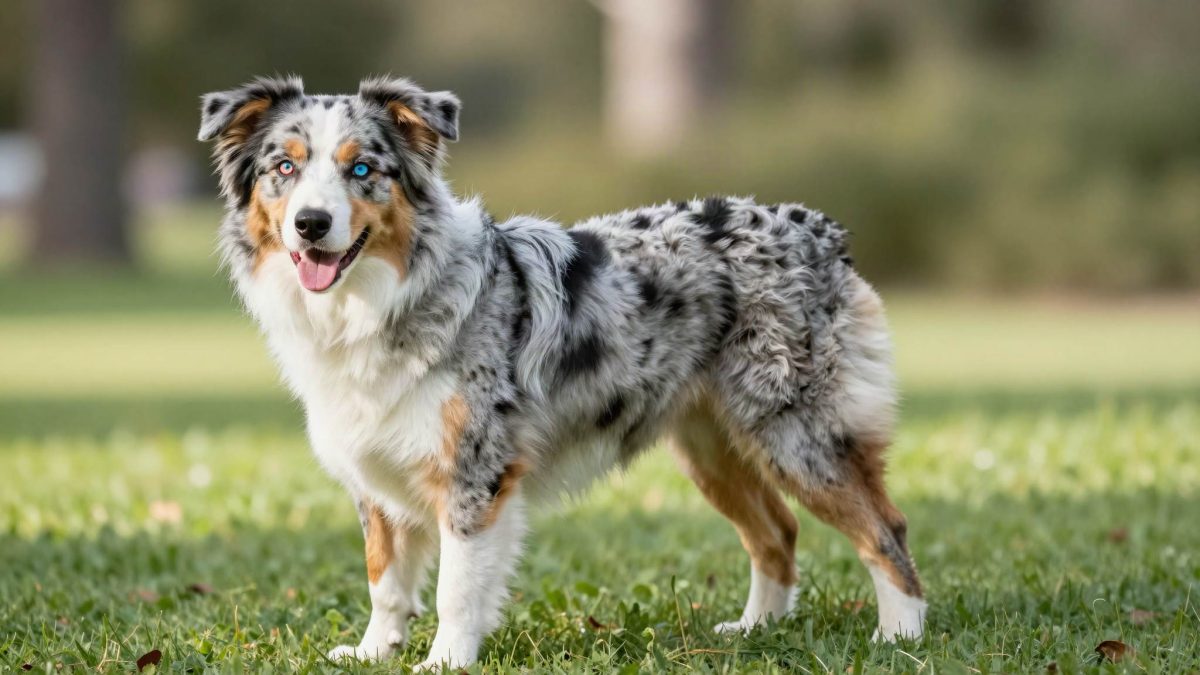
Every dog has its own energy level. Some breeds are content to nap all day. Others, like Labradors, need regular exercise to stay happy. Then there’s the Australian Shepherd, a breed that seems to run on an entirely different scale.
Whether it’s a long walk, a run, a trip to the dog park, or an agility course, the Australian Shepherd always seems to have more energy in the tank.
Active, family-oriented, and highly intelligent, this breed is a loyal companion suited to families and individuals alike. However, Australian Shepherds were originally bred as working guard and herding dogs, and they still need a job to feel truly fulfilled. Here’s everything you need to know about this striking, high-energy breed.
Australian Shepherd Basics
According to the Australian Shepherd Club of America, the breed’s working heritage is evident in its build. The Australian Shepherd is medium-sized, with a deep chest, a body slightly longer than it is tall, and fairly straight forelimbs that support agility and endurance.
Depending on sex, they typically stand 18 to 23 inches tall and weigh between 40 and 65 pounds. Their coats are medium length, slightly coarse, and weather-resistant, allowing them to work in a range of conditions. Common coat colors include blue merle, red merle, black, and red, usually with white and tan markings.
Australian Shepherds also have bright, alert eyes that reflect their intelligence — working dogs use an intense stare, sometimes called “the eye,” to direct cattle and sheep. Eye color is usually brown, but it’s not uncommon for Australian Shepherds, especially merles, to have blue eyes or even heterochromatic eyes (one blue, one brown).
The Tireless, Playful Australian Shepherd Personality
The Australian Shepherd is like the friend who runs marathons, gets promoted at work, and still makes time for everyone around them. They want to be involved in everything and somehow have the energy to do it all.
Though bred for work, Australian Shepherds thrive around people of all ages, including children, as well as other dogs and even smaller pets like cats, provided they’re properly socialized early on.
Many Australian Shepherd owners describe their dogs as treating their entire household, humans and other pets alike, as a herd to watch over, even if the dog has never set foot on an actual ranch.
A Quick History of the Australian Shepherd
Despite the name, Australian Shepherds didn’t actually originate in Australia. Their history is American, by way of Spain.
The breed as we know it today developed in 19th-century California, shaped by the demanding and varied terrain of the American West. While there’s some debate over the exact details, many experts believe the breed’s ancestors were herding dogs brought to the United States by Basque shepherds, whose herding tradition originated in the mountains between Spain and France.
Caring for an Australian Shepherd
It’s hard to overstate how much stimulation Australian Shepherds need to be happy. These dogs were bred to work long hours in demanding conditions, and that instinct doesn’t just disappear in a home setting — they need both physical exercise and mental engagement to thrive.
Giving an Aussie the Exercise They Need
Australian Shepherds need a substantial amount of exercise, ideally at least an hour a day, and often more. This holds true for both standard and miniature Australian Shepherds. But physical exercise alone isn’t enough; their minds need a workout too.
Even after hours of running, an under-stimulated Australian Shepherd may develop destructive or anxious behaviors, such as excessive chewing, digging, or barking. Mental stimulation matters just as much as physical activity in keeping these dogs balanced and content.
Whether it’s a game of hide-and-seek, agility training, a backyard obstacle course, or ongoing obedience work, you’ll notice a real shift in your Australian Shepherd’s demeanor once their sharp mind has a job to do. They have a natural herding instinct and a genuinely quick intelligence that thrives on structured activity.
Common Health Issues in Australian Shepherds
Australian Shepherds are generally a healthy breed, but there are a few health-related issues that owners should watch for.
Allergies
One of the most common issues Australian Shepherds face is allergies, particularly skin allergies. Typical symptoms include excessive scratching, foot licking, hot spots, ear infections, and hair loss.
These allergies can be triggered by environmental factors like pollen or fleas, as well as certain foods. If your Australian Shepherd shows these symptoms, it’s worth consulting a veterinarian to determine the underlying cause and the right treatment plan.
Anxiety
Like many highly intelligent breeds, Australian Shepherds tend to experience higher rates of anxiety when they don’t have an outlet for their physical and mental energy. They also tend to bond closely with their families and can struggle with being left alone.
Because of this, it’s important to start training Australian Shepherds early on healthy alone-time habits, gradually building up their comfort with separation so it doesn’t become a source of chronic stress.