
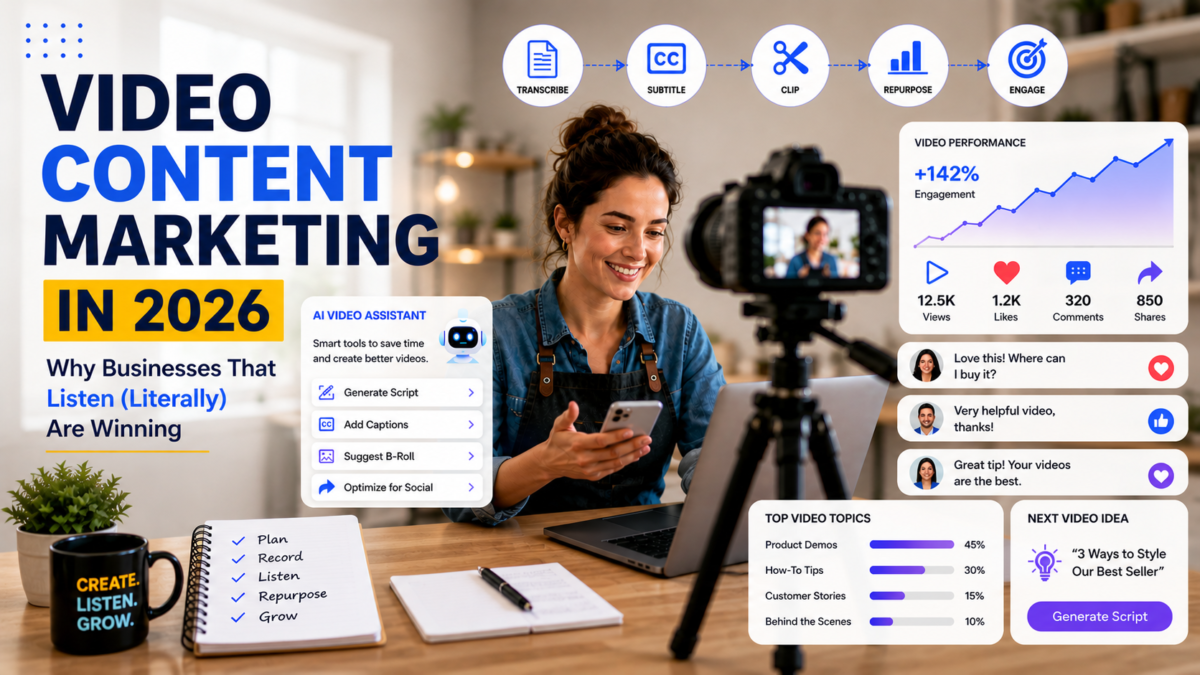
Let’s be honest for a second: nobody has time to read a 1,500-word blog post about your product anymore. They do, however, have thirty seconds to watch a video whilst waiting for the kettle to boil. That’s not a criticism of modern attention spans, it’s just where we are. And if you’re running a business in 2026 without a proper video content marketing strategy, you’re leaving a rather large chunk of your audience on the table.
The good news? You don’t need a Hollywood budget or a production team the size of a small army to make video work for you. You need a clear plan, a few smart tools, and a willingness to actually listen to what your customers are telling you sometimes quite literally, through the audio you’re already sitting on.
This article walks through why video content marketing has become non-negotiable for businesses of every size, how to make your existing content work twice as hard, and a few practical shortcuts that will save you hours every single week.
Why Video Content Marketing Isn’t Optional Anymore
A few years ago, the video was “nice to have.” A polished extra. Something you’d get around to once the website was sorted and the email list was ticking along nicely.
That’s no longer the case.
Search engines favour pages with video. Social platforms actively push video content harder than static images or text posts. And real, living, scrolling customers genuinely prefer to watch something being explained rather than read three paragraphs about it.
Video content marketing has quietly become the backbone of how businesses build trust, explain complex products, and stay visible in increasingly crowded feeds.
If you’re still treating video as an occasional add-on rather than a core part of your content strategy, you’re competing with one hand tied behind your back.
The Content You Already Have Is Worth More Than You Think
Here’s something a lot of business owners miss: you’re probably already sitting on a goldmine of content and don’t realise it.
Think about it. Every webinar you’ve hosted. Every podcast episode you’ve recorded. Every customer testimonial call. Every internal training session. Every product demo you filmed once and forgot about. That’s all raw material and most of it is just gathering digital dust in a folder somewhere.
The trick to smart video content marketing isn’t always about creating more content from scratch. It’s about repurposing what already exists into formats that work harder for you. A single 40-minute webinar can become:
- A blog post (using the transcript as your foundation)
- Five or six short social clips
- An email newsletter
- A downloadable guide
- Multiple subtitled video snippets for platforms where sound is often off by default
This is where things get genuinely useful. Converting spoken content into written text using a decent audio to text tool turns a single recording into a searchable, editable, endlessly repurposable document.
Suddenly, that webinar you recorded six months ago becomes three blog posts, a set of FAQs, and the backbone of a new landing page. That’s proper efficiency.
Accessibility Isn’t a Bonus Feature It’s Basic Good Practice
Here’s a statistic that tends to surprise people: a huge proportion of video views on social media happen with the sound completely off. People are on the bus, in the office, trying not to disturb the person next to them, or simply scrolling out of habit without headphones plugged in.
If your video relies entirely on audio to get its message across, you’re losing a significant chunk of your audience before they’ve even had the chance to engage.
This is precisely why subtitles have gone from “nice touch” to essential. Adding captions doesn’t just help viewers who are hard of hearing or who speak English as a second language although that matters enormously too.
It keeps sound-off viewers engaged, it improves watch time (which platforms reward), and it makes your content genuinely more accessible to a wider range of people.
The good news is that this no longer needs to be a tedious manual job. A reliable subtitle generator can take your raw footage and produce accurate captions in a fraction of the time it would take to type them out by hand. What used to eat up an entire afternoon can now be sorted before your coffee’s gone cold.
Building a Video Content Marketing Strategy That Actually Sticks
Right, so you know video matters and you know your existing content is more valuable than you thought. Where do you actually start?
1. Start With What Your Audience Is Already Asking
Before filming anything, look at your customer service inbox, your comments section, and your sales team’s most frequently answered questions. These are gold. If people keep asking the same three questions, that’s your first three videos, sorted.
2. Keep It Short, Keep It Honest
You don’t need slick production values as much as you need honesty and clarity. A slightly imperfect video that answers a genuine question will almost always outperform a beautifully shot video that says nothing useful. Aim for authenticity over polish audiences can smell a script from a mile off.
3. Repurpose Relentlessly
As mentioned above, don’t let a single piece of content die after one use. Record once, distribute many times, across many formats. Turn the audio into text, turn the text into a blog, turn the blog into social snippets, and turn those snippets into subtitled clips for platforms where sound is optional.
4. Optimise for Search, Not Just Social
Video content marketing isn’t just about social media reach. Search engines increasingly favour pages that include video, especially when accompanied by a proper transcript. Adding a written version of your video’s content alongside the clip itself gives search engines something to actually crawl and index, whilst also giving readers who prefer text an alternative way to consume your content.
5. Make Accessibility Part of the Process, Not an Afterthought
Build subtitle creation into your standard workflow rather than treating it as a last-minute scramble before publishing. It should be as automatic as hitting export.
Common Mistakes Businesses Make With Video Content
Even well-intentioned businesses trip up in a few predictable ways. Here are the ones worth watching for:
- Treating every platform the same. A video built for LinkedIn shouldn’t be identical to one built for a short-form platform. Formats, lengths, and tone need adjusting.
- Ignoring the first three seconds. If your video doesn’t hook attention almost instantly, viewers scroll on. Simple as that.
- Forgetting captions entirely. As covered above, this alone can cost you a significant chunk of engagement.
- Never repurposing. Filming once and using it once is, frankly, a waste of a good asset.
- Overproducing. Spending three weeks editing a ninety-second clip is rarely a good use of anyone’s time or budget.
The Bigger Picture: Trust, Not Just Traffic
It’s easy to get caught up chasing views, likes, and watch-time percentages. Those numbers matter, sure. But the real value of a solid video content marketing strategy is trust. When someone watches you explain something clearly, patiently, and honestly, they start to see your business as credible. That trust is what eventually turns a casual viewer into a paying customer.
Written content still matters enormously, nobody’s suggesting you abandon blogging or email marketing. But video, when done thoughtfully and made accessible to as many people as possible, adds a human dimension that plain text simply can’t replicate.
Final Thoughts
Video content marketing in 2026 isn’t about chasing trends or trying to go viral. It’s about being genuinely useful, consistently visible, and easy to engage with regardless of whether someone’s watching with the sound on, scrolling with it off, or reading a transcript on their lunch break.
Start small if you need to. Repurpose what you’ve already got. Make accessibility part of your process rather than an afterthought. And above all, keep it real audiences can tell the difference between a business that’s genuinely trying to help and one that’s just performing for the algorithm.
Frequently Asked Questions
Do I need expensive equipment to start with video content marketing?
Not at all. A decent smartphone, reasonable lighting, and clear audio will get you further than most people expect. Consistency and clarity matter far more than production value, especially when you’re just starting out.
How often should a small business publish video content?
There’s no magic number, but consistency beats frequency. One well-thought-out video a week will outperform five rushed ones. Start with a pace you can realistically sustain and build from there.
Why do subtitles matter so much if people can just turn the sound on?
Because most won’t. A large percentage of social video is watched with the sound off, particularly on mobile. Subtitles keep your message accessible regardless of where or how someone’s watching.
Can old webinars or recorded calls really be turned into new content?
Absolutely. Any recorded audio or video, whether it’s a webinar, a podcast, or a customer call, can be transcribed and reshaped into blog posts, social clips, email content, and more. It’s one of the most efficient ways to stretch your content budget.
Is video content marketing suitable for every industry?
Yes, though the format will differ. A tradesperson might film quick how-to clips, whilst a consultancy might favour explainer videos or client testimonials. The principle stays the same across every sector: show, don’t just tell.
What’s the biggest mistake businesses make with video?
Publishing once and moving on. The businesses that see the best results are the ones that repurpose a single piece of content across multiple formats and platforms, rather than treating each video as a one-off.