
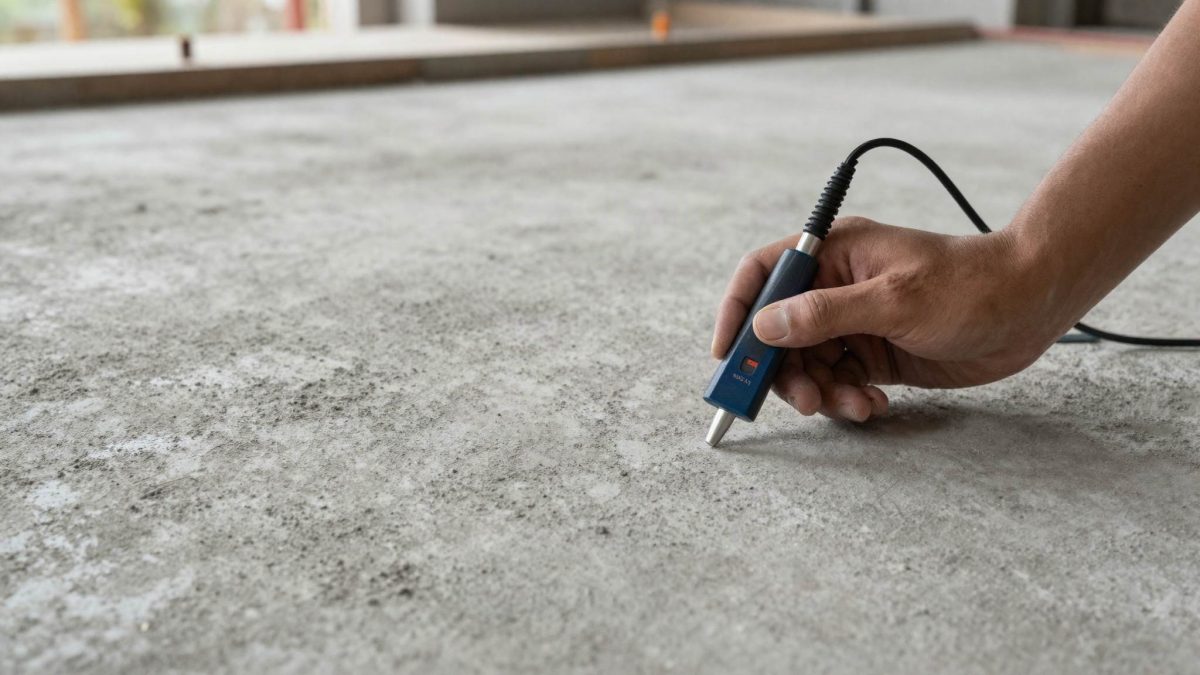
Concrete is one of the most versatile materials used in constructing many famous structures seen today. Its main qualities are strength, longevity, and the ability to withstand harsh forces of nature, which is a testament to many Roman buildings that still stand to this very day.
However, concrete is also very complex and can hide inherent faults, invisible to the eye, that may adversely affect its properties.
Moisture and Condensation
At first impression, concrete seems like a dry and solid substance, but it’s actually a very porous material that can absorb moisture from its surroundings. Moisture that finds its way into concrete can fundamentally alter its properties and damage any surface coating typically placed on top of a concrete floor or slab.
This moisture can come from below the slab or from above it, which is why it’s prudent to test the concrete surface for moisture content before deciding on the type of final finish to apply.
A simple home test is to tape a section of plastic onto a section of the concrete floor and leave it for at least twenty-four hours; any visible dampness on the floor or condensation on the plastic sheet suggests there’s excess moisture within the concrete.
In-Situ RH Testing
There are a couple of professional tests that can be done to quantify the amount of moisture in a concrete slab: the in-situ relative humidity test, also known as the ASTM F2170 test.
The in-situ RH test involves inserting a small sensor probe into a hole drilled into the concrete, through a sleeve. The device provides an instant reading and is rated as the most accurate relative humidity test for concrete, because the probes are relatively unaffected by conditions or environmental changes on the surface.
This test is the one most widely accepted because it provides a prediction of how much moisture could occur at the slab surface in the future. Based on these readings, the floor coating or covering can be selected and applied with confidence that it will hold up over the long term without issues.
The Hood Test
Another test used to quantify the percentage of relative humidity in a concrete slab or floor is the ASTM F2420 test, also known in the trade as the Hood test.
The reason for running this test is that moisture permeating from the concrete slab or floor can degrade or affect various types of floor systems. Floor coverings might be made of wood, textile materials, or specialized epoxy or rubber coatings, and excessive moisture coming from the concrete base can damage these coatings or coverings over time.
Manufacturers of these flooring systems typically require specific moisture and humidity testing before any installation takes place over concrete floor slabs.
By choosing professionally certified testing laboratories for concrete testing, you can rest assured that any coating applied to the concrete will last for a long time.
Advanced Moisture Testing, an ICRI-certified company, consults on moisture testing and carries out relative humidity tests to properly gauge flooring conditions and ensure a correct installation.