
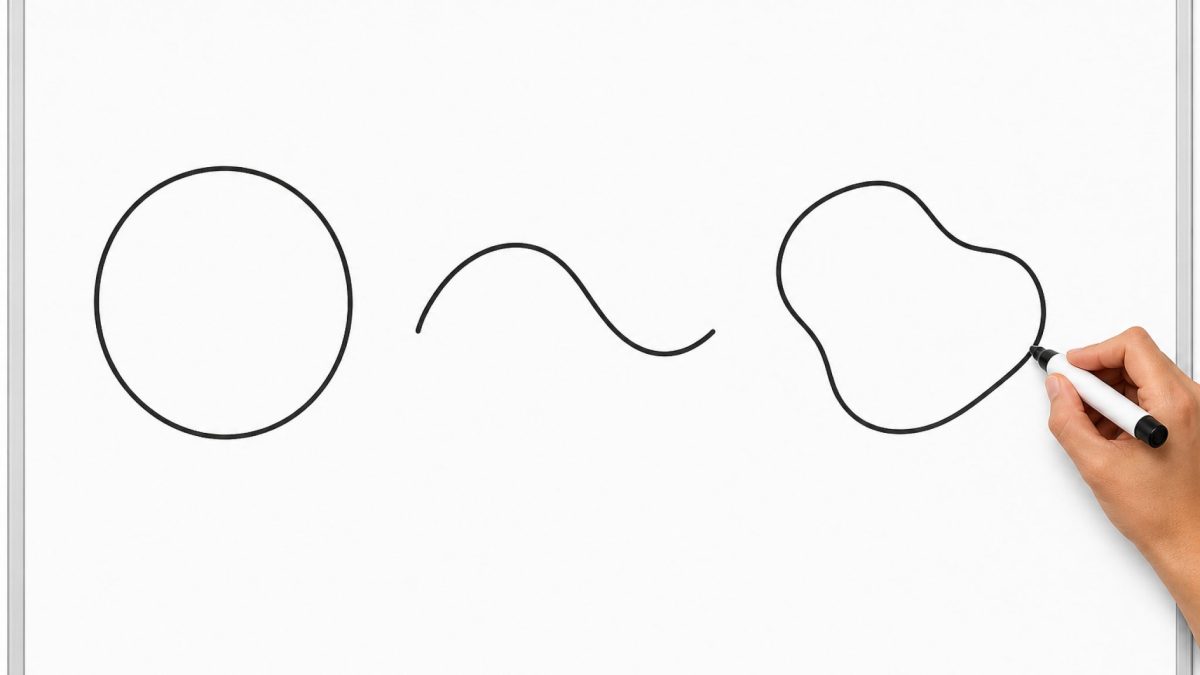
A curve — the path of a continuously moving point — is an abstract concept in mathematics. Usually, such a path is created by a curved line. The word can also be applied to a line or to a series of line segments connected end to end.
A curved shape is a path that can enclose one or more regions. Ellipses, circles, and polygons are simple examples. Open curves, like parabolas and spirals, have endless length.
Shape of a Curve
Ellipses, circles, and conic sections are two-dimensional curved shapes, along with arcs, sectors, and segments. In contrast, three-dimensional curved shapes, like cylinders, spheres, and cones, are referred to differently.
Types of Curves
Curves are classified into different categories. Here are some examples of types of curves:
- Simple Curve: A curve that changes direction but doesn’t intersect itself. A curve of this type is called a simple curve. It can be either an open or a closed simple curve.
- Non-simple curve: A non-simple curve is one that crosses its own path. It means the curve intersects itself as it changes direction.
- Open curve: A curve with two ends is known as an open curve because it doesn’t enclose a region within itself.
- Closed curve: When a curve has no endpoints and encloses a region or area, it’s known as a closed curve. This type of curve forms when the two ends of an open curve are joined.
- Upward Curve: An upward curve is a curve that points in an upward direction. Cup-shaped or bell-shaped rising curves are terms used to describe upward curves.
- Downward Curve: The term “downward curve” refers to a curve that bends downward. Cup-shaped or bell-shaped falling curves are terms used to describe downward curves.
Examples of simple closed curves:
Triangle: A triangle is a type of plane figure with three sides, and the vertex is where two sides meet end to end. Between two sides, an angle is formed.
This is one of the most important aspects of geometry. The Pythagorean theorem and trigonometry, for example, are both based on triangle characteristics. The angles and sides of a triangle determine its type.
A triangle is a two-dimensional closed shape. It’s a plane figure made up of straight lines forming three sides. The vertex is the intersection of two straight lines. As a result, there are three vertices in a triangle, and each vertex creates a unique angle.
In mathematics, every shape has specific characteristics that set it apart from others. Let’s look at some characteristics of triangles:
- Three sides and three angles form a triangle.
- A triangle’s interior angles must add up to 180 degrees.
- A triangle’s exterior angles always add up to 360 degrees.
- A supplementary angle is the sum of adjacent interior and exterior angles.
- Any two sides of a triangle have a combined length greater than the length of the third side. Similarly, the difference in length between any two sides of a triangle is smaller than the length of the third side.
Circle: A circle is a curve traced out by a point moving in a plane so that its distance from a given point is constant. In other words, it’s the shape formed by all points in a plane that are at a fixed distance from a given point, the center.
The radius is the distance between any point on the circle and the center. A circle, specifically, is a curved shape that divides the plane into two regions: interior and exterior.
In everyday usage, the word “circle” can refer to either the figure’s boundary or the complete figure, including its interior. In precise technical terms, the circle is only the boundary, and the entire figure is referred to as a disc.
Using the calculus of variations, a circle can also be described as a special type of ellipse in which the two foci coincide and the eccentricity is zero, or as the two-dimensional shape enclosing the maximum area per unit of perimeter squared.
Square: A square is a regular quadrilateral with all four sides of equal length and all four angles equal. The square’s angles are right angles, equal to 90 degrees. Additionally, the square’s diagonals are equal and intersect each other at 90 degrees.
A parallelogram with two pairs of opposite sides of equal length is also referred to as a square. A square is a quadrilateral plane figure with all four sides of equal length and all angles measuring 90 degrees.
A square’s shape is such that if it’s sliced through the middle, each half is symmetrical. Each half of the square resembles a parallelogram with equal sides on each side.
Learn more about basic geometrical concepts.
We hope the above information is useful for you.