
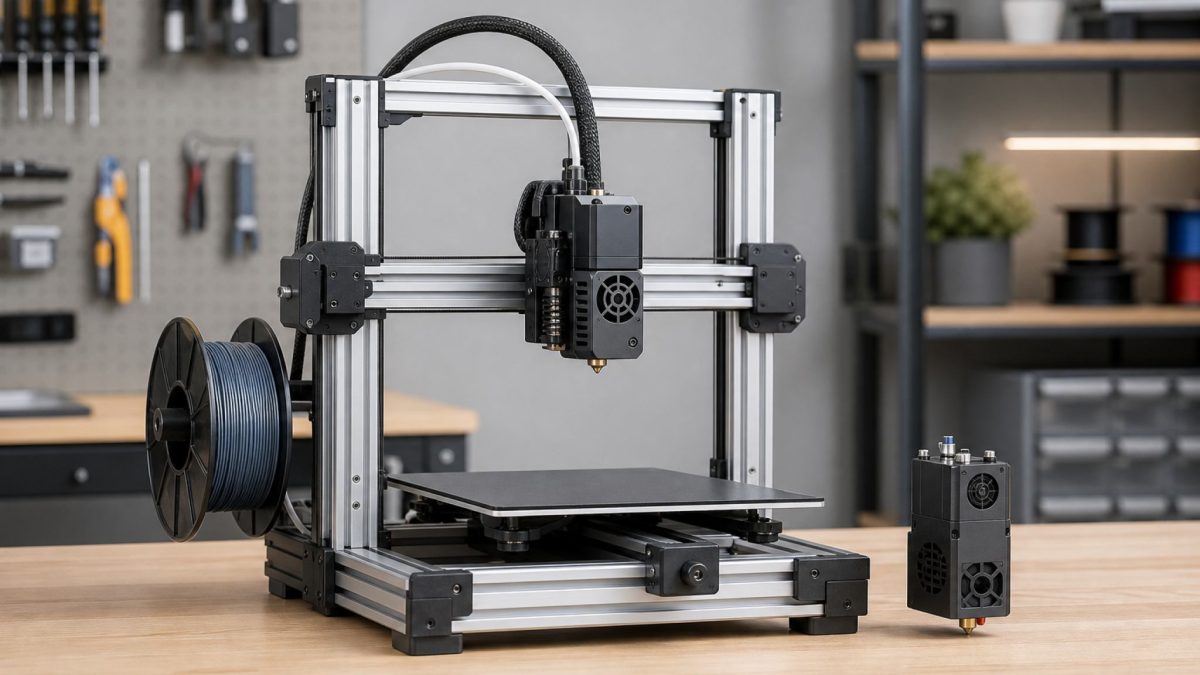
Snapmaker, a company known for all-in-one 3D printing, laser engraving, and CNC carving solutions, makes the Snapmaker Modular 3D Printer. Instead of buying three separate machines, users get one frame that switches between all three functions by swapping out a toolhead module.
That modularity is the machine’s main selling point. A hobbyist might start with 3D printing, then add the laser module to engrave designs onto wood or acrylic, or the CNC module to carve and cut rigid materials — all without needing separate equipment or workspace for each process.
The Snapmaker Modular 3D Printer is controlled through Snapmaker Luban, the company’s own slicing and control software, along with a built-in touchscreen for standalone use without a computer connected. It’s aimed at hobbyists, makers, and small businesses that want to prototype or produce across multiple mediums without a large equipment budget.
How does it work?
The machine is built around a shared linear-module frame. Each function — 3D printing, laser engraving, or CNC carving — has its own toolhead module that attaches to that frame. Switching tasks means detaching the current toolhead and locking in the one you need, a process most users can do in a few minutes without tools beyond what’s included.
Snapmaker Luban handles the software side of that switch: selecting a different module in the software loads the relevant settings, tool paths, and controls for that function, so users aren’t manually reconfiguring the machine each time.
Because the frame, motors, and control board are shared across all three functions, the total footprint and cost stay closer to a single machine than three — the tradeoff being that only one function can be active at a time, unlike owning three dedicated machines that could run in parallel.
Here are some steps to keep a Snapmaker Modular 3D Printer running well over time:
- Clean regularly: Wipe down the print bed, nozzle, and linear rails periodically to prevent debris buildup and reduce the risk of clogs or binding.
- Check bed leveling before each print: An unlevel bed is one of the most common causes of failed prints — recheck it regularly and adjust as needed.
- Use quality filament to avoid clogging, warping, and other print-quality issues tied to inconsistent material.
- Recalibrate the machine periodically to maintain accuracy across all three toolhead modules.
- Store the machine somewhere clean and dry when not in use to protect the electronics and moving parts from dust and moisture.
- Keep the firmware updated — Snapmaker periodically ships updates that improve performance and fix known issues.
With regular maintenance, a Snapmaker Modular 3D Printer can reliably deliver consistent 3D prints, laser engravings, and CNC-carved work for years.